
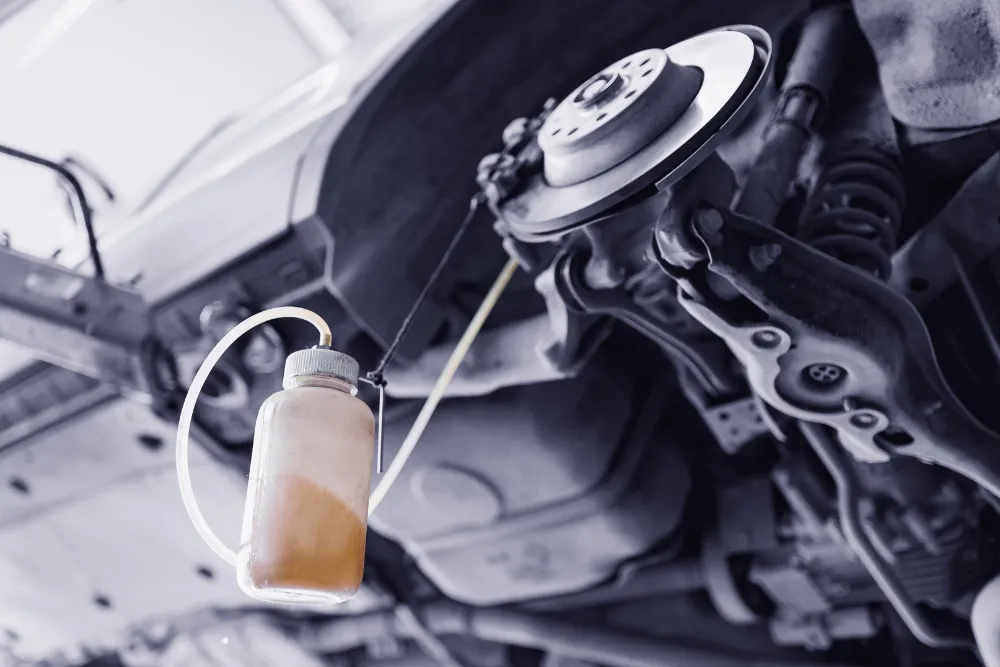
When was the last time you thought about your brake fluid? Most drivers in New Braunfels focus on brake pads and rotors, but brake fluid is just as critical to your stopping power. At Clark’s Auto Service, we see brake fluid neglect contribute to soft pedal feel, ABS damage, and accelerated corrosion in braking systems more often than you might expect.
In South Texas, where humidity levels run high throughout much of the year, moisture contamination in brake fluid is a real concern that affects drivers across Comal County, Canyon Lake, Seguin, Schertz, and San Marcos. A brake fluid flush is not just routine maintenance. It is a safety measure that protects your vehicle’s entire braking system.
What Brake Fluid Does
Your brakes do not work on mechanical force alone. When you press the brake pedal, hydraulic pressure travels through brake fluid to clamp the brake pads against your rotors and slow the vehicle. Without clean, properly pressurized fluid, that hydraulic transfer breaks down.
Why Fluid Condition Matters
Brake fluid is hygroscopic, meaning it naturally absorbs moisture from the surrounding environment over time. Once water enters the system, a few things happen:
- The boiling point of the fluid drops significantly
- Metal components inside brake lines, calipers, and the master cylinder begin to corrode
- Braking performance becomes inconsistent, especially under hard stops or repeated braking on hills
- ABS and other brake-assist systems can be compromised
Fresh brake fluid typically has a dry boiling point above 400 degrees Fahrenheit. Contaminated fluid with as little as 3% water content can have its boiling point reduced dramatically, increasing the risk of brake fade during heavy use.
Why South Texas Makes Brake Fluid Flush Especially Important
Living in New Braunfels and the surrounding Comal County area comes with a specific challenge: humidity. Unlike drivers in drier climates, South Texas drivers deal with moisture-heavy air for a significant portion of the year. That atmospheric moisture accelerates the rate at which brake fluid becomes contaminated.
The Humidity Factor
Even a vehicle that is well-maintained and parked indoors is not immune. Brake systems are not perfectly sealed from the environment. Over time, moisture works its way in through reservoir caps, rubber brake hoses, and micro-permeations in the system. In a humid climate like the San Marcos and Canyon Lake corridor, this process moves faster than it would in the desert Southwest.
The result is fluid that has absorbed more water than it should, sitting inside brake lines and calipers where it quietly corrodes metal surfaces and reduces the reliability of your stopping power.
What Moisture Contamination Looks Like in Practice
- A soft or spongy brake pedal that compresses further than it used to
- A pedal that gradually sinks toward the floor when held at a stop
- Longer stopping distances that are hard to explain
- Rust-colored or dark brake fluid when the reservoir is inspected
- ABS warning lights that appear without an obvious cause
If you are experiencing any of these symptoms, it may be time to schedule a brake inspection at Clark’s Auto Service in New Braunfels, TX. Give us a call at 830-625-1172 or stop by at 2951 Interstate 35 S, New Braunfels, TX 78130 to have your system checked by our team.
How a Brake Fluid Flush Works
A brake fluid flush is a straightforward service, but it requires the right approach to do it properly. It is not the same as simply topping off the fluid reservoir.
The Difference Between a Top-Off and a Flush
Topping off brake fluid adds fresh fluid to the reservoir but does nothing to remove contaminated fluid from the rest of the system. Brake lines, calipers, and the ABS modulator still hold old, moisture-laden fluid that continues to cause problems.
A proper flush involves:
- Draining the old fluid from the entire hydraulic system
- Bleeding the brakes at each wheel to clear air and old fluid completely
- Refilling with fresh fluid that meets your vehicle’s manufacturer specification
- Inspecting brake lines, calipers, and the master cylinder for signs of existing corrosion or wear
At Clark’s Auto Service, our technicians don’t just flush and move on. Every brake service includes a thorough inspection of your hydraulic system to make sure everything is working as it should before you leave our shop.
How Often Should You Flush Brake Fluid in New Braunfels?
There is no universal answer, but there are reliable guidelines based on both manufacturer recommendations and real-world driving conditions in Texas.
General Service Intervals
Most vehicle manufacturers recommend a brake fluid flush every two years or 24,000 miles, whichever comes first. However, in humid climates like New Braunfels and the broader Comal County area, erring on the shorter end of that range makes sense.
A few factors that may warrant more frequent service:
- Driving in stop-and-go traffic regularly around New Braunfels or San Marcos
- Towing or hauling heavy loads, which creates more heat in the braking system
- Vehicles with older rubber brake hoses that may allow moisture absorption at a faster rate
- Fleet vehicles with high mileage accumulation
If you are unsure where your vehicle stands, a quick fluid test can tell you. Brake fluid test strips measure the moisture content and boiling point, giving a clear picture of whether service is needed now or can wait. Not sure how to interpret the results? Bring your vehicle into Clark’s Auto Service and we will test it for you and give you a straight answer.
Protecting Your ABS and Long-Term Brake Components
Many drivers do not connect brake fluid maintenance to ABS performance, but the relationship is direct. The ABS modulator is one of the most sensitive and expensive components in your braking system. It contains small solenoid valves and channels that are vulnerable to corrosion from contaminated fluid.
The Cost of Ignoring Fluid Maintenance
Replacing an ABS modulator can run several hundred dollars or more depending on the vehicle. A brake fluid flush, by comparison, is a fraction of that cost. Staying current on fluid maintenance is one of the most cost-effective forms of preventative maintenance you can do for your vehicle.
At Clark’s Auto Service, our goal has always been to help you understand what your vehicle needs now and what can wait, so you can make an informed decision rather than feel pressured into unnecessary repairs.
Why New Braunfels Drivers Trust Clark’s Auto Service for Brake Service
- Years of experience – serving New Braunfels and Comal County drivers since 1976, so we know what South Texas vehicles go through.
- ASE Master-certified technicians – including Honda and Subaru Master Techs, who bring verified expertise to every brake inspection and fluid service.
- Nationwide Warranty coverage – on brake repairs: 2 years and 24,000 miles, and on some repairs, 3 years and 3,000 miles through TechNet.
- Family-owned and community-focused – which means honest recommendations, no unnecessary upsells, and a team that treats your vehicle like it belongs to someone we know.
- Convenient amenities – a waiting room, shuttle service, and an early bird/night drop box so brake service fits your schedule without the hassle.
FAQs About Brake Fluid Flush for New Braunfels Drivers
How often should brake fluid be flushed in Texas?
Most vehicles in Texas should have brake fluid flushed every two years or 24,000 miles. In humid regions like South Texas, the shorter end of that range is often recommended because moisture contamination occurs more quickly.
Does humidity affect brake fluid in New Braunfels?
Yes, humidity directly accelerates brake fluid contamination. Brake fluid is hygroscopic, meaning it absorbs moisture from the air, and high humidity environments like New Braunfels and Comal County speed up that process. Contaminated fluid lowers braking performance over time.
What happens if brake fluid absorbs moisture?
When brake fluid absorbs moisture, its boiling point drops, increasing the risk of brake fade during hard stops. It also promotes internal corrosion in brake lines, calipers, and ABS components, which can lead to costly repairs if left unaddressed.
Is brake fluid flush necessary every 2 years?
For most drivers, yes. Manufacturer guidelines and industry recommendations align on a two-year or 24,000-mile interval. Testing the fluid’s moisture content is the most accurate way to confirm whether service is due before hitting that mark.
Where can I get brake service near Canyon Lake?
Drivers near Canyon Lake can get brake service in nearby New Braunfels, which is the closest full-service auto repair area in Comal County. Look for a shop with ASE-certified technicians and a solid warranty on brake work for the best long-term value.
Schedule Your Brake Fluid Flush in New Braunfels Today
Your brakes are the most important safety system on your vehicle. Do not let contaminated fluid quietly compromise them. Whether you are in New Braunfels, Canyon Lake, Seguin, Schertz, San Marcos, or anywhere in Comal County, Clark’s Auto Service is here to help you stay safe on the road.
Visit us at 2951 Interstate 35 S, New Braunfels, TX 78130, call 830-625-1172, or request an appointment online. We are open Monday through Friday, and we make it easy to drop your vehicle off early with our night drop box.