

Your EV battery has one enemy it can’t outrun: heat. In New Braunfels, TX, where summer temperatures push triple digits for weeks at a time, your vehicle’s cooling system is the only thing standing between your battery pack and long-term degradation. EV cooling system service keeps that protection intact, and most owners don’t think about it until performance drops or range shrinks. At Clark’s Auto Service, we want to change that.
This guide walks you through how EV thermal management works, what symptoms mean your cooling system needs attention, how EVs and gas vehicles compare on this service, and why getting ahead of it in summer is the smartest move you can make for your vehicle.
Do EVs Have Cooling Systems? (Yes, and They're More Complex Than You Think)
One of the most common misconceptions about electric vehicles is that they run cool because there’s no combustion engine. That’s only partly true. EVs and hybrids still generate significant heat, it just comes from different sources.
What Gets Hot in an Electric or Hybrid Vehicle
- Battery pack: Lithium-ion cells generate heat during charging and discharging. Too much heat degrades the battery faster and reduces its capacity over time.
- Electric motor and inverter: These components convert stored energy into motion and produce heat in the process.
- On-board charger: Fast charging in particular produces high thermal load.
- Power electronics module: Manages voltage conversion and also generates heat under load.
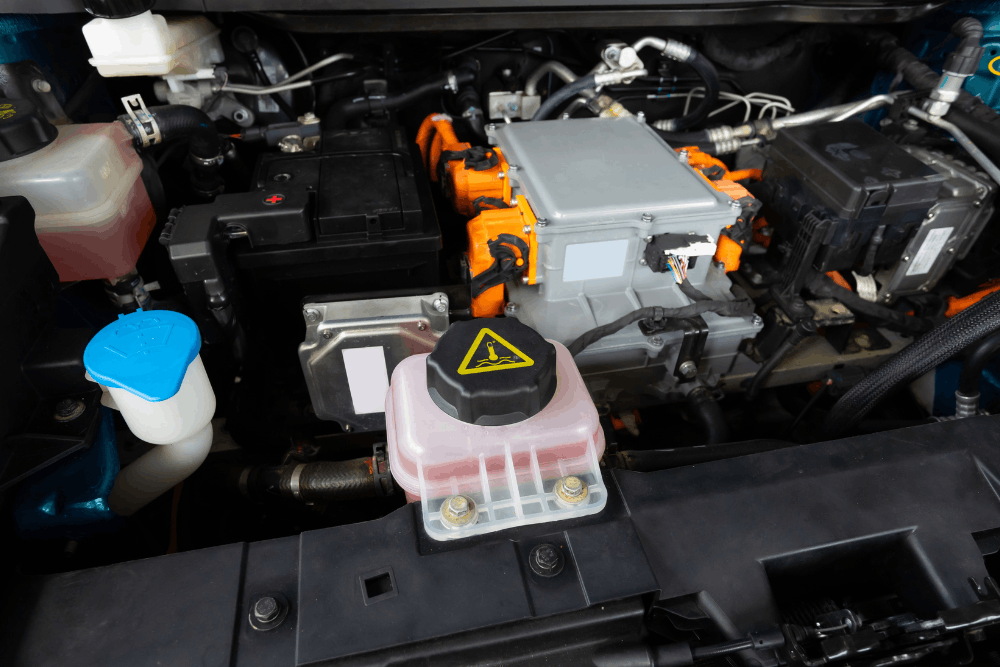
Each of these components requires dedicated cooling, and in most modern EVs and hybrids, this is handled by a liquid-cooled thermal management system that circulates coolant through dedicated circuits, similar to what you’d find in a gas-powered vehicle but purpose-built for electrical components.
How EV Battery Thermal Management Works in New Braunfels, TX Heat
Texas heat is no joke. When ambient temperatures rise into the 90s and 100s, your EV’s thermal management system is running almost constantly just to keep battery temperatures within their ideal operating window, which is typically between 60 and 95 degrees Fahrenheit for lithium-ion packs.
The Two Directions of Thermal Management
Most EV systems need to manage heat in both directions:
- Cooling during hot weather: Prevents heat-related degradation, reduces the chance of thermal runaway, and maintains full battery capacity on hot summer days.
- Warming during cold weather: Keeps the battery warm enough for efficient charging and energy delivery, which matters even in Texas during winter cold snaps.
In New Braunfels, TX, the summer demand on your vehicle’s cooling circuits is sustained and intense. Drivers who regularly park outdoors, tow, or use frequent DC fast charging put extra thermal load on the system compared to those with shaded parking or primarily Level 2 home charging.
What Happens When the Cooling System Falls Behind
When the thermal management system can’t keep up, the vehicle’s battery management software steps in with a process called thermal throttling. This limits how much power the battery delivers or accepts to protect the cells.
You’ll notice this as:
- Reduced acceleration or power output
- Slower charging speeds, especially on fast chargers
- A warning message or reduced-range notification on the dash
None of these are emergencies on their own, but they are signs the system is being pushed and that a cooling system inspection is worth scheduling.
EV Cooling Systems vs. Gas Vehicle Cooling Systems
Here’s something worth understanding: an EV cooling system and a traditional engine cooling system share the same basic principle (circulate coolant, transfer heat, repeat) but are engineered for entirely different purposes.
| Feature | Gas Vehicle Cooling | EV/Hybrid Cooling |
|---|---|---|
| Primary heat source | Engine combustion | Battery, motor, inverter |
| Coolant circuits | Usually one main loop | Multiple dedicated loops |
| Temperature range | 195 to 220 degrees F for engine | 60 to 95 degrees F for battery |
| Failure consequence | Engine overheating | Battery degradation, reduced range |
| Coolant type | Standard engine coolant | Often a dielectric, non-conductive fluid |
The coolant used in EV battery circuits is not the same as what goes in a gas engine. In many EVs, it must be a non-conductive formula specifically to prevent electrical shorts if a line develops a small leak. Using the wrong fluid in an EV cooling circuit is a serious error. This is why EV and hybrid cooling service should always be handled by technicians who understand these differences, not treated as a routine coolant top-off.
Warning Signs Your EV or Hybrid Needs Cooling System Service in New Braunfels
You don’t have to wait for a dashboard warning to know something needs attention. Here are the signs worth paying attention to:
- Reduced range on hot days: More than a 10 to 15 percent drop in expected range on a hot day (above baseline warm-weather range estimates) can indicate cooling inefficiency.
- Longer charging times than usual: If DC fast charging is slower than it used to be, thermal limits may be triggering early.
- Battery temperature warnings: Any warning related to battery temperature or thermal management should be addressed promptly.
- Unusual cabin odors: A sweet or chemical smell near the battery area can indicate a coolant leak.
- Unexplained coolant loss: A drop in coolant level with no known cause can indicate a leak in the cooling circuit and requires a professional inspection before further damage occurs.
If any of these symptoms sound familiar, the team at Clark’s Auto Service in New Braunfels, TX is equipped to inspect and service EV and hybrid cooling systems. Call us at 830-625-1172 or visit us at 2951 Interstate 35 S, New Braunfels, TX 78130 to schedule an appointment.
How Often Should EV Coolant Be Serviced Near New Braunfels, TX?
EV cooling system maintenance intervals vary by manufacturer, but a general rule used across the industry is to inspect the system every two years or 30,000 miles, with coolant replacement typically recommended around 5 years or 150,000 miles for many models.
What Affects Your Service Interval
Your actual service timeline depends on several factors:
- Driving intensity: Frequent highway driving, towing, or regular DC fast charging accelerates thermal wear.
- Climate: Sustained high temperatures, like those common in the Texas Hill Country during summer, place more demand on cooling circuits year-round.
- Charging habits: Level 2 charging generates less heat than DC fast charging. Frequent fast charging shortens coolant service intervals.
- Manufacturer specifications: Always cross-reference your owner’s manual. Some vehicles call for earlier service under specific conditions.
For hybrids, the cooling picture is more complex. A hybrid has both a combustion engine cooling system and a separate hybrid battery cooling system, each with its own fluid and maintenance requirements. Both need to be tracked and serviced on their own schedule.
Why Skipping This Service Costs More Than It Saves
Degraded coolant loses its ability to transfer heat efficiently. Over time, it can also become corrosive, leading to damage inside the cooling passages, heat exchanger, and pump seals. A coolant flush and refill is one of the most cost-effective maintenance items on an EV or hybrid. Replacing a degraded battery pack or heat exchanger is not.
Why Clark's Auto Service Is Ready for Your EV or Hybrid in New Braunfels, TX
Clark’s Auto Service has been serving drivers in New Braunfels, TX since 1976. Nearly 50 years of experience working on domestic, European, and Asian vehicles has built the kind of technical depth that carries over into the modern EV and hybrid era.
Here is what sets the shop apart for EV and hybrid owners:
- ASE-certified technicians: Several of our technicians hold ASE Master certifications, along with Honda and Subaru master tech credentials, two brands known for leading the way in hybrid technology.
- The right scan tools for the job: Our technicians work with professional and factory-level scan tools to check cooling system health and confirm your vehicle’s needs before and after service.
- BG Products: Clark’s uses BG fluid service products, a professional-grade line trusted across the industry for fluid maintenance quality.
- Nationwide warranty: Qualifying repairs are backed by our TechNet nationwide warranty of 2 years/24,000 miles, and 3 years/36,000 miles on some repairs. Join our rewards program and that coverage extends to 4 years/48,000 miles, giving you even greater peace of mind on every service.
- Family-owned accountability: The team at Clark’s Auto Service has built their reputation on straightforward service and getting the job done right the first time.
EV and hybrid service isn’t a niche specialty reserved for dealerships. With the right tools, the right training, and a commitment to accuracy, an independent shop can handle this work just as well, and with a lot more personal attention.
FAQs About EV Cooling System Service
Do EVs have cooling systems?
Yes, EVs have dedicated liquid cooling systems that regulate the temperature of the battery pack, electric motor, and power electronics. Without this system, heat generated during driving and charging would degrade battery cells and reduce vehicle performance and range.
Can heat affect EV battery performance?
Yes, high heat directly reduces an EV battery’s ability to deliver and accept energy efficiently. In extreme temperatures, the battery management system may throttle power output or charging speed to protect the cells from heat-related damage.
How often should EV coolant be serviced?
Most manufacturers recommend inspecting EV cooling systems every two years or 30,000 miles, with full coolant replacement typically needed around 150,000 miles or five years. Driving habits, climate, and charging frequency all affect this interval.
Are EV cooling systems different from gas vehicles?
Yes, EV cooling systems are engineered for lower operating temperatures and often use non-conductive dielectric coolant to prevent electrical shorts near battery cells. Gas vehicles use standard engine coolant in a single loop, while EVs may have multiple dedicated cooling circuits.
How much does EV cooling system service cost in New Braunfels, TX?
EV cooling system service costs vary based on the vehicle make, model, and what the service includes, such as inspection only, coolant flush, or component repair. For an accurate estimate specific to your vehicle, bring it in for a professional inspection at a qualified local shop.
Schedule Your EV Cooling System Service in New Braunfels, TX Today
Your EV or hybrid battery is the most expensive component in the vehicle. Keeping its cooling system in good shape is one of the simplest ways to protect that investment, especially heading into a Texas summer.
Schedule your EV cooling system service today with the team at Clark’s Auto Service. Visit us at 2951 Interstate 35 S, New Braunfels, TX 78130, or call 830-625-1172 to book your appointment. We also serve drivers from Seguin, San Marcos, Schertz, and the surrounding Hill Country communities.
We look forward to keeping you safe on the road.